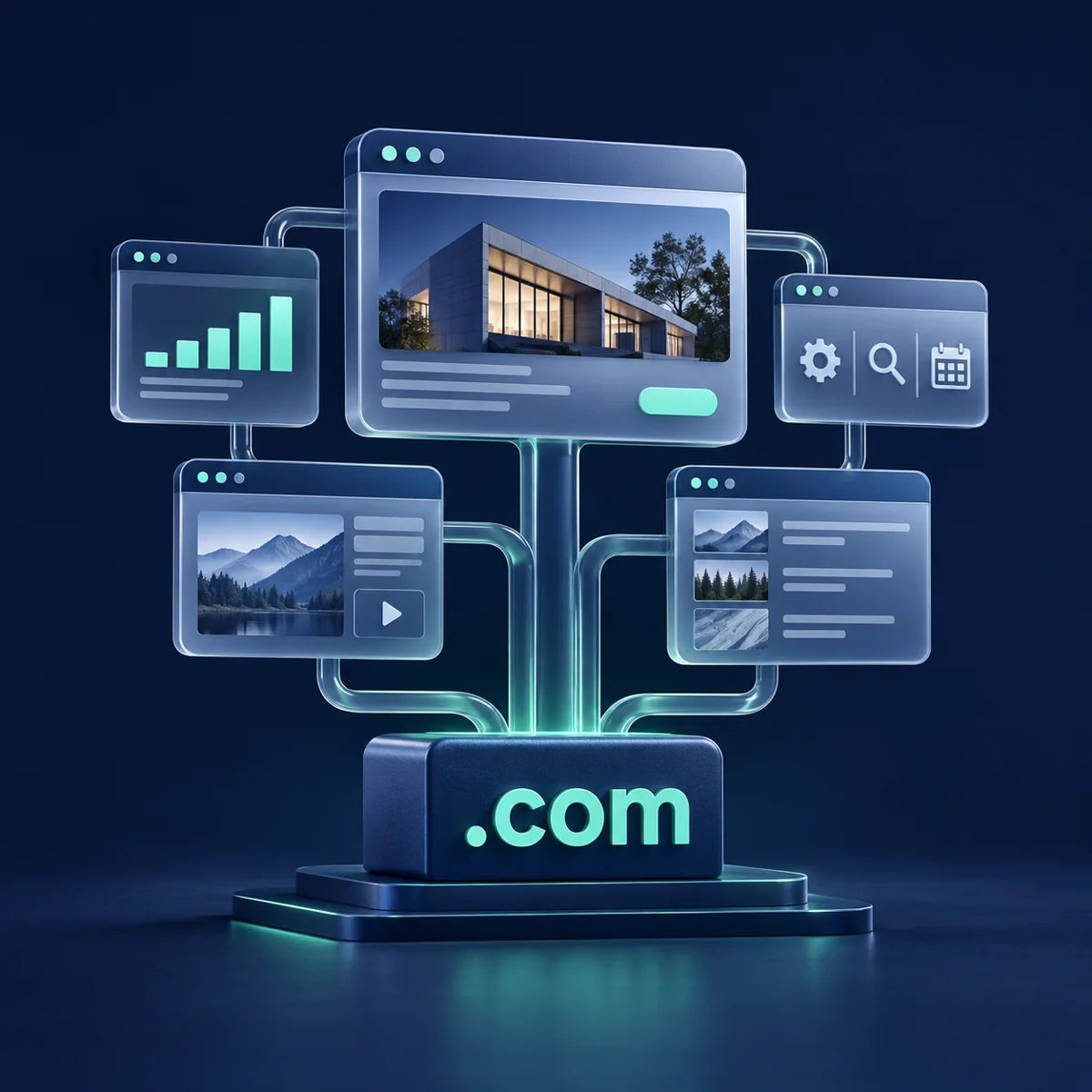
Domain development turns an address you own into a useful destination. Ricochet Agency helps plan and build primary websites and ancillary domain properties around a defined audience, practical content, and a business purpose, with search engine optimization and answer engine optimization considered as part of the work.
The opportunity may be a specialist publication, a research resource, a directory, a calculator, or a supporting property for an established business. We start by asking what a visitor should gain from the site. A domain should earn its place through usefulness, not simply repeat the same sales message under another name.
Give each domain a clear role
A portfolio often contains names with different potential uses. Some may support the main brand, some may suit independent products, and others may be better candidates for sale or a straightforward redirect. Building a separate website is an investment in ongoing operations as well as an initial launch.
We help assess the intended audience, existing resources, commercial objective, and likely maintenance burden before recommending a direction. For example, an educational domain might justify an independent resource if you have relevant expertise and an editorial plan. If it only duplicates an existing service page, developing it separately may add complexity without a convincing user benefit.
Develop ancillary properties with purpose
An ancillary domain is a supporting property with a distinct job. It might host an industry glossary, a genuinely useful comparison tool, a research library, or a publication serving a narrower audience than your primary company website. The relationship between the properties should be understandable to visitors.
We can plan how that property introduces your organization, handles inquiries, and connects to relevant resources. Ownership disclosures, editorial responsibilities, and appropriate commercial labeling should be part of the brief. The goal is a coherent group of useful destinations, not a collection of websites that pretend to be unrelated endorsements of the same business.
Build an SEO foundation
Our proposed development scope can include an organized site structure, descriptive page titles, meaningful internal links, mobile layouts, sensible indexation controls, and content that matches the site’s purpose. We also consider what the visitor can do after finding an answer: compare options, use a tool, contact your team, or continue reading.
Where a domain already has a website, we review what should be retained before changing URLs or replacing content. Search-related decisions should be documented alongside the launch plan. An exact-match address or an older registration is not a guarantee of rankings, traffic, or commercial demand, and we do not build a proposal around that assumption.
Make answer-engine work practical
We use AEO to describe work aimed at making useful information easier to discover and understand in answer-oriented search experiences. That can mean clear explanations, relevant supporting evidence, current organization details, accessible text, and pages that answer a real customer question without obscuring the answer behind a sales pitch.
Google’s guidance for generative AI search emphasizes foundational SEO, useful original content, and clear technical structure. It also says special AI files or special structured data are not required for its generative search features. We do not promise citations by an AI system, preferred placement, or inclusion in any particular answer.
Create content worth maintaining
A useful development plan identifies who knows the subject, where supporting information comes from, and how pages will be reviewed. Original tools, first-hand explanations, clear methodologies, and properly attributed research give a property a more specific purpose than a large collection of generic articles.
For example, a comparison resource should explain what is being compared and when the information was checked. A professional directory should have listing standards and a way to correct errors. We can structure the publishing system around those needs, but subject-matter review and any regulated claims must have an accountable owner.
Avoid shortcut site networks
Ancillary development should not become a doorway-page campaign, a manufactured backlink network, or mass duplication across similar domains. Google’s spam policies identify doorway abuse, link spam, expired-domain abuse, and scaled content created primarily to manipulate rankings as prohibited practices. We plan around distinct user value rather than those shortcuts.
Links between related properties should help the reader understand or complete a task. A genuine tool can naturally be relevant to your main website without every page being built around keyword-rich links. We also consider when a single stronger website is the better choice than several properties competing for the same content and attention.
Plan conversion, measurement, and operations
Before building, agree what the property should achieve and how you will assess it. Useful measures may include qualified inquiries, tool completions, repeat visits, or subscriptions. Search visibility can be part of the picture, but it should not obscure whether the site helps visitors or contributes to the business.
We can also define form handling, private inquiry records, notification routing, content editing, and administrative access. Hosting, renewals, software updates, and editorial maintenance need named responsibilities. Measurement tools and any consent requirements should be selected for the actual project rather than added automatically.
Discuss your domain development plan
For a portfolio project, begin with a small number of properties you can support properly. Give each one a written audience brief, a content owner, a conversion objective, and a review schedule. Decide which pages belong on the primary website and which genuinely need a separate identity. We can use that map to discuss build priorities and avoid commissioning overlapping sites. Launching fewer well-defined resources also makes it easier to see which ideas deserve further investment and which should be revised or retired.
Tell us the domains involved, your primary business, the audience you want to serve, and the resources available to maintain the project. Include your current website and whether you want an independent brand, a supporting publication, or an interactive product.
We will discuss fit and a separately scoped development engagement. If the project needs software, see Custom App Development; if an existing premium website may be a better starting point, explore Stealth Website Acquisition. Rankings, traffic, answer-engine mentions, and revenue are not guaranteed deliverables.